Subsection 4.3.1 Introduction
Objectives: Important Topics of this Section
-
The Logarithmic function as the inverse of the exponential function
-
Writing logarithmic and exponential expressions
-
-
-
-
Solving exponential equations
-
Converting between periodic and continuous growth rate
A population of 50 flies is expected to double every week, leading to a function of the form
\(f(x)=50(2)^{x}\text{,}\) where
\(x\) represents the number of weeks that have passed. When will this population reach 500? Trying to solve this problem leads to solving the equation
\(500=50(2)^{x}\text{.}\) Dividing both sides by 50 to isolate the exponential gives
\(10=2^{x}\text{.}\)
While we have set up exponential models and used them to make predictions, you may have noticed that solving exponential equations has not yet been mentioned. The reason is simple: none of the algebraic tools discussed so far are sufficient to solve exponential equations. Consider the equation
\(2^{x}=10\) above. We know that
\(2^{3}=8\) and
\(2^{4}=16\text{,}\) so it is clear that
\(x\) must be some value between 3 and 4 since
\(g(x)=2^{x}\) is increasing. We could use technology to create a table of values or graph to better estimate the solution.
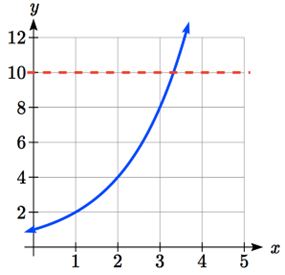
From the graph, we could better estimate the solution to be around 3.3. This result is still fairly unsatisfactory, and since the exponential function is one-to-one, it would be great to have an inverse function. None of the functions we have already discussed would serve as an inverse function and so we must introduce a new function, named
\(\log\) as the inverse of an exponential function. Since exponential functions have different bases, we will define corresponding logarithms of different bases as well.
Subsection 4.3.2 Logarithmic Functions
Definition 4.3.1. Logarithm.
The logarithm (base
\(b\)) function, written
\(x=\log_{b}(y)\text{,}\) is the inverse of the exponential function (also base
\(b\)),
\(b^{x}=y\text{.}\) In other words, the logarithm calculates the exponent needed on
\(b\) in order to achieve the output of
\(y\text{.}\)
Since the logarithm and exponential are inverses, it follows that:
Definition 4.3.2. Properties of Logarithms: Inverse Properties.
Since \(b^{x}=y\) and \(\log_{b}(y)=x\) are inverse functions;
-
\(\displaystyle \log_{b}(b^{x})=x\)
-
\(\displaystyle b^{\log_b(y)}=y\)
Recall from the definition of an inverse function that if
\(f(a)=c\text{,}\) then
\(f^{-1}(c)=a\text{.}\) Applying this to the exponential and logarithmic functions, we can convert between a logarithmic equation and its equivalent exponential.
Definition 4.3.3. Logarithm Equivalent to an Exponential.
The statement
\(b^{a}=c\) is equivalent to the statement
\(\log_{b}(c)=a\text{.}\)
Alternatively, we could show this by starting with the exponential function
\(c=b^{a}\text{.}\) Since these expressions are equal, it must be true that we should get the same output when we input these terms into the function
\(\log_{b}\text{.}\) That is,
\(\log_{b}(c)=\log_{b}(b^{a})\text{.}\) Using the inverse property of logarithms, we see that
\(\log_{b}(c)=a\text{.}\)
Example 4.3.4.
Write these exponential equations as logarithmic equations:
-
\(\displaystyle 2^{3}=8\)
-
\(\displaystyle 5^{2}=25\)
-
\(\displaystyle 10^{-4}=\dfrac{1}{10000}\)
Solution.
-
\(2^{3}=8\) is equivalent to
\(\log_{2}(8)=3\)
-
\(5^{2}=25\) is equivalent to
\(\log_{5}(25)=2\)
-
\(10^{-4}=\dfrac{1}{10000}\) is equivalent to
\(\log_{10}(\dfrac{1}{10000})=-4\)
Example 4.3.5.
Write these logarithmic equations as exponential equations:
-
\(\displaystyle log_{6}(\sqrt{6})=\dfrac{1}{2}\)
-
\(\displaystyle log_{3}(9)=2\)
Solution.
-
\(\log_{6}(\sqrt{6})=\dfrac{1}{2}\) is equivalent to
\(6^{\frac{1}{2}}=\sqrt{6}\)
-
\(\log_{3}(9)=2\) is equivalent to
\(3^{2}=9\)
Checkpoint 4.3.6.
Write the exponential equation
\(4^{2}=16\) as a logarithmic equation.
By establishing the relationship between exponential and logarithmic functions, we can now solve basic logarithmic and exponential equations by rewriting.
Example 4.3.7.
Solve
\(\log_{4}(x)=2\) for
\(x\text{.}\)
Solution.
By rewriting this expression as an exponential,
\(4^{2}=x\text{,}\) so
\(x = 16\text{.}\)
Example 4.3.8.
Solve
\(2^{x}=10\) for
\(x\text{.}\)
Solution.
By rewriting this expression as a logarithm, we get
\(x=\log_{2}(10)\text{.}\)
While this does define a solution, and an exact solution at that, you may find it somewhat unsatisfying since it is difficult to compare this expression to the decimal estimate we made earlier. Also, giving an exact expression for a solution is not always useful - often we really need a decimal approximation to the solution. Luckily, this is a task calculators and computers are quite adept at. Some calculators are only able to evaluate logarithms of two bases, while others can evaluate a logarithm of any base. In the event that a calculator can only evaluate certain logarithms, we will look a technique that allows us to evaluate any base of logarithm. The logarithms that are normally represented on calculators are as follows:
Definition 4.3.9. Common and Natural Logarithms.
The common log is the logarithm with base 10, and is typically written
\(\log(x)\text{.}\)
The natural log is the logarithm with base
\(e\text{,}\) and is typically written
\(\ln(x)\text{.}\)
Example 4.3.10.
Evaluate
\(\log(1000)\) using the definition of the common log.
Solution.
To evaluate
\(\log(1000)\text{,}\) we can let
\(x=\log(1000)\text{,}\) then rewrite into exponential form using the common log base of 10:
\(10^{x}=1000\text{.}\)
From this, we might recognize that 1000 is the cube of 10, so
\(x = 3\text{.}\)
We also can use the inverse property of logarithms to write
\(\log_{10}(10^{3} )=3\text{.}\)
Checkpoint 4.3.11.
Evaluate
\(\log(1000000)\text{.}\)
Example 4.3.12.
Evaluate
\(\ln(\sqrt{e})\text{.}\)
Solution.
We can rewrite
\(\ln(\sqrt{e})\) as
\(\ln(e^{\frac{1}{2}})\text{.}\) Since
\(\ln\) is a logarithm with base
\(e\text{,}\) we can use the inverse property for logs:
\(\ln(e^{\frac{1}{2}})=\log_{e}(e^{\frac{1}{2}})=\dfrac{1}{2}\text{.}\)
Example 4.3.13.
Evaluate
\(log(500)\) using your calculator or computer.
Solution.
Using a computer, we can evaluate
\(\log( 500)\approx 2.69897\text{.}\)
To utilize the common or natural logarithm functions to evaluate expressions like
\(\log_{2}(10)\text{,}\) we need to establish some additional properties.
Definition 4.3.14. Properties of Logs: Exponent Property.
\(\log_{b}(A^{r})=r\log_{b}(A)\)
To show why this is true, we offer a proof: Since the logarithmic and exponential functions are inverses,
\(b^{\log_b(A)}=A\text{.}\) Raising both sides to the
\(r\) power, we get
\(A^{r}=(b^{\log_b(A)})^{r}\text{.}\) Utilizing the exponential rule that states
\((x^{p} )^{q}=x^{pq}\text{,}\) \(A^{r}=b^{r\log_b(A) }\text{.}\) Taking the log of both sides,
\(\log_{b}(A^{r})=\log_{b}(b^{r\log_b(A)})\text{.}\) Utilizing the inverse property on the right side yields the result:
\(\log_{b}(A^{r})=r\log_{b}(A)\text{.}\)
Example 4.3.15.
Rewrite
\(\log_{3}(25)\) using the exponent property for logs.
Solution.
Since
\(25 = 52\text{,}\) \(\log_{3}(25)=\log_{3}(5^{2})=2\log_{3}(5)\text{.}\)
Example 4.3.16.
Rewrite
\(4\ln(x)\) using the exponent property for logs.
Solution.
Using the property in reverse,
\(4\ln(x)=\ln(x^{4})\text{.}\)
Checkpoint 4.3.17.
Rewrite using the exponent property for logs:
\(\ln(\dfrac{1}{x^2})\text{.}\)
The exponent property also allows us to find a method for changing the base of a logarithmic expression.
Definition 4.3.18. Properties of Logs: Change of Base.
\(\log_{b}(A)=\dfrac{\log_c( A)}{\log_c(b)}\)
As a proof of this property: Let
\(\log_{b}(A)=x\text{.}\) Rewriting this as an exponential gives
\(b^{x}=A\text{.}\) Taking the log base
\(c\) of both sides of this equation gives
\(\log_{c}(b^{x})=\log_{c}(A)\text{.}\) Now utilizing the exponent property for logs on the left side,
\(x\log_{c}(b)=\log_{c}(A)\text{.}\) Dividing both sides by
\(\log_{c}(b)\text{,}\) we obtain
\(x=\dfrac{\log_c(A)}{\log_c(b)}\text{.}\) Replacing our original expression for
\(x\text{,}\) \(\log_{b}(A)=\dfrac{\log_c(A) }{\log_c(b)}\text{.}\)
With this change of base formula, we can finally find a good decimal approximation to our question from the beginning of the section.
Example 4.3.19.
Evaluate
\(\log_{2}(10)\) using the change of base formula.
Solution.
According to the change of base formula, we can rewrite the function
\(\log_{2}\) as a ratio of logarithms of any other base. Since our calculators can evaluate the natural log, we might choose to use the natural logarithm, which is the log base
\(e\text{:}\)\(\log_{2}(10)=\dfrac{\ln(10)}{\ln(2)}\)
Using a calculator to evaluate this, we find
\(\dfrac{\ln(10)}{ln(2)}\approx \dfrac{2.30259}{0.69315}\approx 3.3219\text{.}\)
This finally allows us to answer our original question - the population of flies we discussed at the beginning of the section will take about 3.32 weeks to grow to 500.
Example 4.3.20.
Evaluate
\(\log_{5}(100)\) using the change of base formula.
Solution.
We can rewrite this expression using any other base. If our calculators are able to evaluate the common logarithm, we could rewrite using the common log, base 10.
\(\log_{5}(100)=\dfrac{\log_{10}(100)}{\log_{10}(5)}\approx \dfrac{2}{0.69897} \approx 2.861\text{.}\)
While we can solve the basic exponential equation
\(2^{x}=10\) by rewriting in logarithmic form and then using the change of base formula to evaluate the logarithm, the proof of the change of base formula illuminates an alternative approach to solving exponential equations.
Definition 4.3.21. Solving Exponential Equation.
-
Isolate the exponential expressions when possible.
-
Take the logarithm of both sides or rewrite the exponential equation as an equivalent logarithmic equation.
-
Utilize the exponent property for logarithms to pull the variable out of the exponent.
-
Use algebra to solve for the variable.
Example 4.3.22.
Solve
\(2^{x}=10\) for
\(x\text{.}\)
Solution.
Using this alternative approach, rather than rewrite this exponential into logarithmic form, we will take the logarithm of both sides of the equation. Since we often wish to evaluate the result to a decimal answer, we will usually utilize either the common log or natural log. For this example, we’ll use the natural log:
\(\ln(2^{x})=\ln(10)\text{.}\) Utilizing the exponent property for logs,
\(x\ln(2)=\ln( 10)\text{.}\) Now dividing by
\(\ln(2)\text{,}\) \(x=\dfrac{\ln(10)}{\ln(2)}\approx 3.3219\text{.}\)
Notice that this result matches the result we found using the change of base formula.
Example 4.3.23.
In the first section, we predicted the population (in billions) of India
\(t\) years after 2008 by using the function
\(f(t)=1.14(1.0134)^{t}\text{.}\) If the population continues following this trend, when will the population reach 2 billion?
Solution.
We need to solve for time
\(t\) so that
\(f(t) = 2\text{.}\) This gives us the equation
\(2=1.14(1.0134)^{t}\text{.}\) Divide both sides by 1.14 to isolate the exponential expression to get the equation
\(\dfrac{2}{1.14}=1.0134^{t}\text{.}\) We can then take the logarithm of both sides of the equation to get
\(\ln(\dfrac{2}{1.14})=\ln(1.0134^{t} )\text{.}\) Apply the exponent property on the right side to yield
\(\ln(\dfrac{2}{1.14})=t\ln(1.0134)\text{.}\) Then, dividing both sides by
\(\ln(1.0134)\) gives us
\(t=\dfrac{\ln(\dfrac{2}{1.14})}{\ln(1.0134)}\approx 42.23 \text{ years}\text{.}\)
If this growth rate continues, the model predicts the population of India will reach 2 billion about 42 years after 2008, or approximately in the year 2050.
Checkpoint 4.3.24.
Solve
\(5(0.93)^{x}=10\text{.}\)
Example 4.3.25.
Solve
\(5(1.07)^{3t}=2\text{.}\)
Solution.
To start, we want to isolate the exponential part of the expression, the
\((1.07)^{3t}\text{,}\) so it is alone on one side of the equation. Then we can use the log to solve the equation. We can use any base log; this time we’ll use the common log.
Starting with
\(5(1.07)^{3t}=2\text{,}\) we divide both sides by 5 to isolate the exponential term. This gives us
\((1.07)^{3t}=\dfrac{2}{5}\text{.}\) Then we take the log of both sides to give
\(\log((1.07)^{3t})=\log(\dfrac{2}{5})\text{.}\) Using the exponent property for logs gives
\(3t\log(1.07)=\log(\dfrac{2}{5})\text{.}\) When we divide by
\(3\log(1.07)\) on both sides we get
\(t=\dfrac{\log(\dfrac{2}{5})}{3\log(1.07)}\approx -4.5143\text{.}\)
In addition to solving exponential equations, logarithmic expressions are common in many physical situations.
Example 4.3.26.
In chemistry, pH is a measure of the acidity or basicity of a liquid. The pH is related to the concentration of hydrogen ions,
\([H^{+}]\text{,}\) measured in moles per liter, by the equation
\(\text{pH}=-\log([H^{+}])\text{.}\)
If a liquid has concentration of 0.0001 moles per liter, determine the pH.
Determine the hydrogen ion concentration of a liquid with pH of 7.
Solution.
To answer the first question, we evaluate the expression
\(-\log(0.0001)\text{.}\) While we could use our calculators for this, we do not really need them here, since we can use the inverse property of logs:
\(-\log(0.0001)=-\log(10^{-4})=-(-4)=4\text{.}\)
To answer the second question, we need to solve the equation
\(7=-\log([H^{+}])\text{.}\) Begin by isolating the logarithm on one side of the equation by multiplying both sides by -1:
\(-7=\log([H^{+}])\text{.}\) Rewriting into exponential form yields the answer:
\([H^{+}]=10^{-7}=0.0000001 \text{ moles per liter}\text{.}\)
Logarithms also provide us a mechanism for finding continuous growth models for exponential growth given two data points.
Example 4.3.27.
A population grows from 100 to 130 in 2 weeks. Find the continuous growth rate.
Solution.
Measuring
\(t\) in weeks, we are looking for an equation
\(P(t)=ae^{rt}\) so that
\(P(0) = 100\) and
\(P(2) = 130\text{.}\) Using the first pair of values,
\(100=ae^{0}\text{,}\) so
\(a = 100\text{.}\)
Using the second pair of values,
\(130=100e^{2r}\text{.}\) Divide by 100 gives us
\(\dfrac{130}{100}=e^{2r}\text{.}\) Take the natural log of both sides to get
\(\ln( 1.3)=\ln(e^{2r})\text{.}\) Use the inverse property of logs to find
\(\ln(1.3)=2r\text{,}\) and thus
\(r=\dfrac{\ln( 1.3)}{2}\approx 0.1312\)
So, this population is growing at a continuous rate of 13.12%per week.
In general, we can relate the standard form of an exponential with the continuous growth form by noting (using \(k\) to represent the continuous growth rate to avoid the confusion of using \(r\) in two different ways in the same formula):
\begin{equation*}
a(1+r)^{x}=ae^{kx}
\end{equation*}
\begin{equation*}
(1+r)^{x}=e^{kx}
\end{equation*}
\begin{equation*}
1+r=e^{k}
\end{equation*}
Definition 4.3.28. Converting Between Periodic to Continuous Growth Rate.
In the equation
\(f(x)=a(1+r)^{x}\text{,}\) \(r\) is the periodic growth rate, the percent growth each time period (weekly growth, annual growth, etc.).
In the equation
\(f(x)=ae^{kx}\text{,}\) \(k\) is the continuous growth rate.
You can convert between these using:
\(1+r=e^{k}\text{.}\)
Remember that the continuous growth rate
\(k\) represents the nominal growth rate before accounting for the effects of continuous compounding, while
\(r\) represents the actual percent increase in one time unit (one week, one year, etc.).
Example 4.3.29.
A company’s sales can be modeled by the function
\(S(t)=5000e^{0.12t}\text{,}\) with
\(t\) measured in years. Find the annual growth rate.
Solution.
Noting that
\(1+r=e^{k}\text{,}\) then
\(r=e^{0.12}-1=0.1275\text{,}\) so the annual growth rate is 12.75%. The sales function could also be written in the form
\(S(t)=5000(1.1275)^{t}\text{.}\)

