Solution.
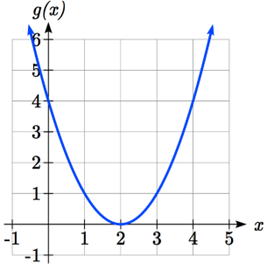
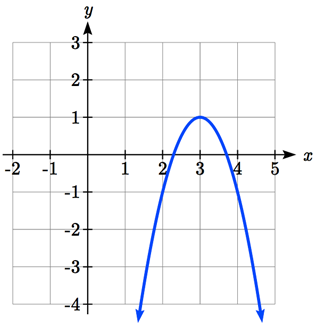
Since this is a quadratic function, first consider what the basic quadratic tool kit function looks like and how this has changed. Observing the graph, we notice several transformations:
The original tool kit function has been flipped over the
\(x\)-axis, some kind of stretch or compression has occurred, and we can see a shift to the right 3 units and a shift up 1 unit.
In total there are four operations:
-
Vertical reflection, requiring a negative sign outside the function
-
Vertical Stretch or Horizontal Compression*
-
Horizontal Shift Right 3 units, which tells us to put
\(x-3\) on the inside of the function
-
Vertical Shift up 1 unit, telling us to add 1 on the outside of the function
* It is unclear from the graph whether it is showing a vertical stretch or a horizontal compression. For the quadratic, it turns out we could represent it either way, so we’ll use a vertical stretch. You may be able to determine the vertical stretch by observation.
By observation, the basic tool kit function has a vertex at
\((0, 0)\) and symmetrical points at
\((1, 1)\) and
\((-1, 1)\text{.}\) These points are one unit up and one unit over from the vertex. The new points on the transformed graph are one unit away horizontally but 2 units away vertically. They have been stretched vertically by two.
Not everyone can see this by simply looking at the graph. If you can, great, but if not, we can solve for it. First, we will write the equation for this graph, with an unknown vertical stretch.
The original function is
\(f(x)=x^{2}\text{.}\) To vertically reflect:
\(-f(x)=-x^{2}\text{.}\) To vertically stretch:
\(-af(x)=-ax^{2}\text{.}\) To shift right by 3 units:
\(-af(x-3)=-a(x-3)^{2}\text{.}\) To shift up by 1 unit:
\(-af(x-3)+1=-a(x-3)^{2}+1\text{.}\)
We now know our graph is going to have an equation of the form
\(g(x)=-a(x-3)^{2}+1\text{.}\) To find the vertical stretch, we can identify any point on the graph (other than the highest point), such as the point
\((2, -1)\text{,}\) which tells us
\(g(2)=-1\text{.}\) Using our general formula, and substituting 2 for
\(x\text{,}\) and -1 for
\(g(x)\text{:}\)
\begin{equation*}
-1=-a(2-3)^{2}+1
\end{equation*}
\begin{equation*}
-1=-a+1
\end{equation*}
\begin{equation*}
-2=-a
\end{equation*}
\begin{equation*}
2=a
\end{equation*}
This tells us that to produce the graph we need a vertical stretch by two. The function that produces this graph is therefore
\(g(x)=-2(x-3)^{2}+1\text{.}\)