Suppose that a square is cut out of cardboard, with each side having length \(L\text{.}\) If we wanted to write a function for the area of the square, with \(L\) as the input and the area as output, you may recall that the area of a rectangle can be found by multiplying the length times the width. Since our shape is a square, the length and the width are the same, giving the formula: \(f(L)=A, f(L)=L\times L=L^{2}.\)
Likewise, if we wanted a function for the volume of a cube with each side having some length \(L\text{,}\) you may recall volume of a rectangular box can be found by multiplying length by width by height, which are all equal for a cube, giving the formula: \(g(L)=V, g(L)=L\times L\times L=L^{3}.\)
A power function is a function that can be represented in the form \(f(x)=x^{p},\) where the base is a variable and the exponent, \(p\text{,}\) is a constant number.
The reciprocal and reciprocal squared functions are both power functions with negative whole number powers since they can be written as \(f(x)=x^{-1}\) and \(f(x)=x^{-2}\text{.}\)
The square and cube root functions are both power functions with fractional powers since they can be written as \(f(x)=x^{\frac{1}{2}}\) or \(f(x)=x^{\frac{1}{3}}\text{.}\)
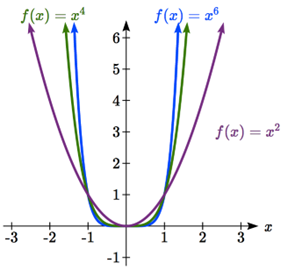
Shown below are the graphs of \(f(x)=x^{2}, f(x)=x^{4}, \text{ and }f(x)=x^{6}\text{,}\) all even whole number powers. Notice that all these graphs have a fairly similar shape, very similar to the quadratic toolkit, but as the power increases the graphs flatten somewhat near the origin, and become steeper away from the origin.
To describe the behavior as numbers become larger and larger, we use the idea of infinity. The symbol for positive infinity is \(\infty\text{,}\) and \(-\infty\) for negative infinity. When we say that "\(x\) approaches infinity", which can be symbolically written as \(x\rightarrow \infty\text{,}\) we are describing a behavior. We are saying that \(x\) is getting large in the positive direction.
With the even power functions, as the \(x\) becomes large in either the positive or negative direction, the output values become very large positive numbers. Equivalently, we could describe this by saying that as \(x\) approaches positive or negative infinity, the \(f(x)\) values approach positive infinity. In symbolic form, we could write: as \(x\rightarrow \pm \infty, f(x)\rightarrow \infty\text{.}\)
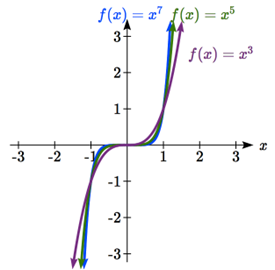
Shown below are the graphs of \(f(x)=x^{3},f(x)=x^{5}\text{,}\) and \(f(x)=x^{7}\text{,}\) all odd whole number powers. Notice all these graphs look similar to the cubic toolkit, but again as the power increases the graphs flatten near the origin and become steeper away from the origin.
For these odd power functions, as \(x\) approaches negative infinity, \(f(x)\) approaches negative infinity. As \(x\) approaches positive infinity, \(f(x)\) approaches positive infinity. In symbolic form we write: as \(x\rightarrow -\infty, f(x)\rightarrow -\infty\) and as \(x\rightarrow \infty, f(x)\rightarrow \infty\text{.}\)
The behavior of the graph of a function as the input takes on large negative values,\(x\rightarrow -\infty\text{,}\) and large positive values, \(x\rightarrow \infty\text{,}\) is referred to as the long run behavior of the function.
Since \(f(x)=x^{8}\) has a whole, even power, we would expect this function to behave somewhat like the quadratic function. As the input gets large positive or negative, we would expect the output to grow without bound in the positive direction. In symbolic form, as \(x\rightarrow \pm \infty, f(x)\rightarrow \infty\text{.}\)
Since this function has a whole odd power, we would expect it to behave somewhat like the cubic function. The negative in front of the \(x^{9}\) will cause a vertical reflection, so as the inputs grow large positive, the outputs will grow large in the negative direction, and as the inputs grow large negative, the outputs will grow large in the positive direction. In symbolic form, for the long run behavior we would write: as \(x\rightarrow \infty, f(x)\rightarrow-\infty\) and as \(x\rightarrow -\infty, f(x)\rightarrow\infty\text{.}\)
An oil pipeline bursts in the Gulf of Mexico, causing an oil slick in a roughly circular shape. The slick is currently 24 miles in radius, but that radius is increasing by 8 miles each week. If we wanted to write a formula for the area covered by the oil slick, we could do so by composing two functions together. The first is a formula for the radius, \(r\text{,}\) of the spill, which depends on the number of weeks, \(w\text{,}\) that have passed.
This formula is an example of a polynomial. A polynomial is simply the sum of terms each consisting of a vertically stretched or compressed power function with non-negative whole number power.
Because of the definition of the "leading" term we often rearrange polynomials so that the powers are descending. \(f(x)=a_{n} x^{n}+.....+a_{2} x^{2}+a_{1} x+a_{0}\)
For the function \(f(x)\text{,}\) the degree is 3, the highest power on \(x\text{.}\) The leading term is the term containing that power, \(-4x^{3}\text{.}\) The leading coefficient is the coefficient of that term, -4.
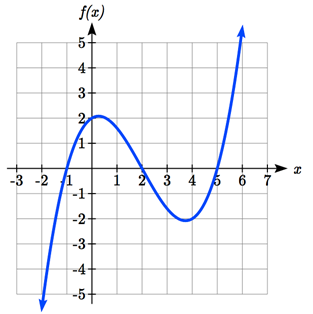
Since the output grows large and positive as the inputs grow large and positive, we describe the long run behavior symbolically by writing: as \(x\rightarrow \infty, f(x)\rightarrow \infty\text{.}\) Similarly, as \(x\rightarrow -\infty, f(x)\rightarrow-\infty\text{.}\)
In words, we could say that as \(x\) values approach infinity, the function values approach infinity, and as \(x\) values approach negative infinity the function values approach negative infinity.
We can tell this graph has the shape of an odd degree power function which has not been reflected, so the degree of the polynomial creating this graph must be odd, and the leading coefficient would be positive.
Like with all functions, the vertical intercept is where the graph crosses the vertical axis, and occurs when the input value is zero. Since a polynomial is a function, there can only be one vertical intercept, which occurs at the point \((0,a_{0})\text{.}\) The horizontal intercepts occur at the input values that correspond with an output value of zero. It is possible to have more than one horizontal intercept.
The horizontal intercepts occur when the output is zero. \(0=(x-2)(x+1)(x-4),\) which is true when \(x = 2, -1\text{,}\) or \(4\text{.}\)\(f(x)\) has zeros, or roots, \(at x = 2, -1\text{,}\) and \(4\text{.}\)
As \(x\) approaches positive and negative infinity, \(f(x)\) approaches negative infinity: \(as x\rightarrow \pm\infty, f(x)\rightarrow\infty\) because of the vertical flip.
As \(x\) approaches infinity (or gets very large in the positive direction) \(f(x)\) approaches infinity; as \(x\) approaches negative infinity (or gets very large in the negative direction) \(f(x)\) approaches negative infinity. (Basically the long run behavior is the same as the cubic function).